Talking about debt with a partner is less about finding someone to blame and more about getting honest about what the debt is costing your household and what options are available.
Before suggesting a Debt Management Program (DMP), agree on the financial problem you’re trying to solve, review the trade-offs and make sure both partners understand how the program works.
If you’re having trouble figuring out whether a DMP makes sense for your situation, free financial counseling can help you review your options together.
Debt has a way of becoming a relationship issue even when it starts as an individual one.
Maybe one person brought credit card balances into the relationship. Or an emergency, job change or rising expenses pushed the household to rely on credit. One partner may be quietly making minimum payments while hoping the balance will eventually move in the right direction.
That can be especially difficult to discuss. A 2025 Bankrate survey found that 40% of people in committed relationships had kept a financial secret from their partner, including 23% who had kept or were keeping secret debt.
So, if bringing up debt feels uncomfortable, you're hardly alone. But avoiding the conversation can make the financial problem harder to solve.
A Debt Management Program (DMP)Debt Management Program (DMP) may be one option for people struggling with eligible unsecured debt, particularly high-interest credit card debt. A DMP through a nonprofit credit counseling agency can combine eligible debts into one monthly payment, while creditors may agree to reduced interest rates or waived fees. It is not a loan, and it is not debt settlement.
The harder part may be deciding how to talk about the possibility with the person you share your life—and possibly your finances—with.
How do you talk to your partner about debt without starting a fight?
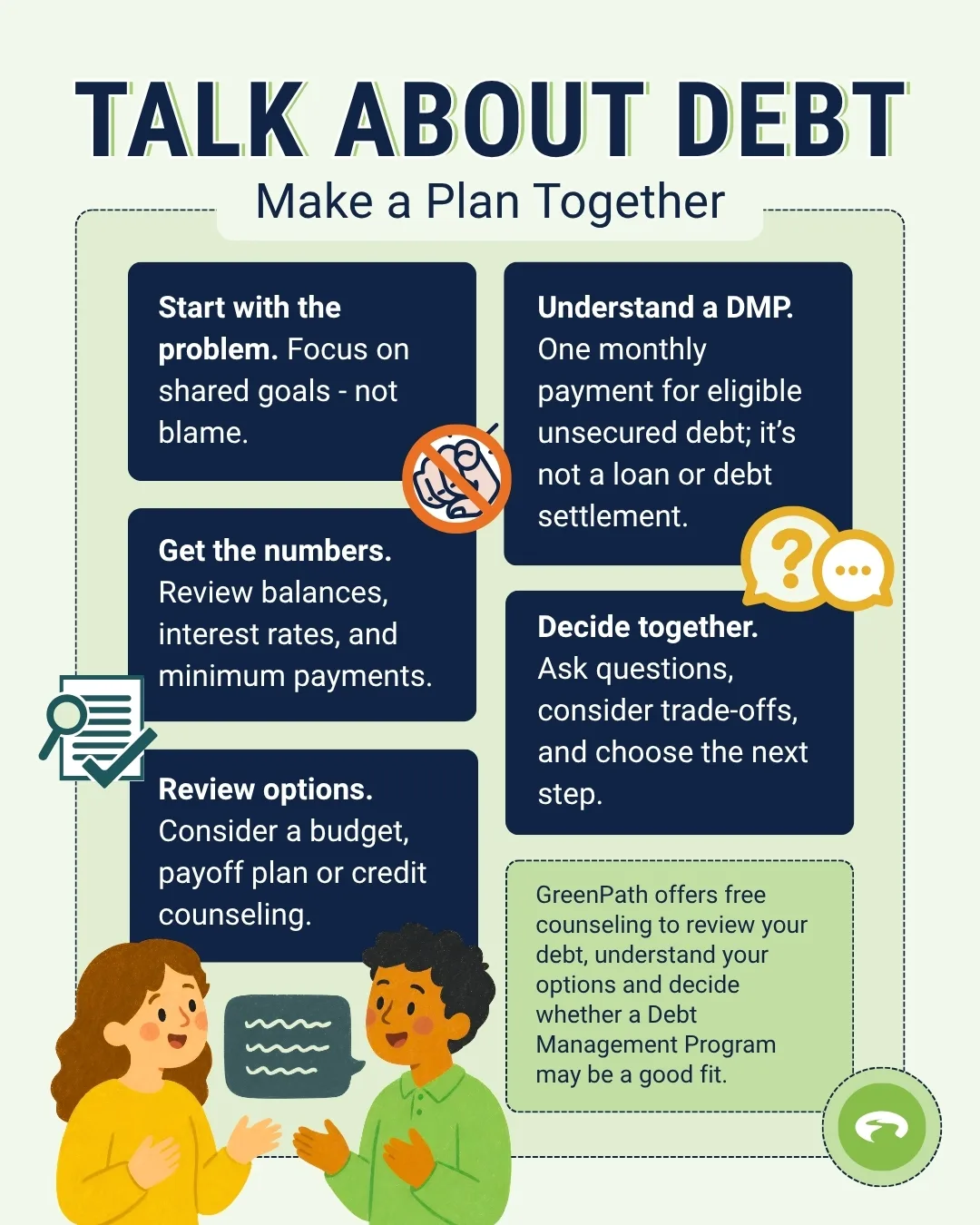
Start with the problem, not the solution.
If you open with, “I think you should go on a debt management program,” your partner may hear criticism, pressure or even a judgment about how they have handled money.
Instead, explain what you have noticed and why you want to talk about it.
You might say:
"I've been looking at our debt payments, and I'm worried that we're putting a lot of money toward interest without making as much progress as we'd like. Can we look at the numbers together and see what options we have?"
That approach changes the conversation from you have a debt problem to we have a financial situation to understand.
Even debt in one person’s name can affect both partners by competing with shared goals such as saving, buying a home or covering unexpected expenses.
The goal of the first conversation isn't to solve everything. It's to make the problem visible.
What should couples discuss before considering a Debt Management Program?
Before deciding whether a DMP is right for you, get specific about the financial picture.
Start with the basics:
- How much debt do we have?
- Which debts have the highest interest rates?highest interest rates?
- What are the minimum monthly payments?
- Are we consistently able to make those payments?
- How much of each payment is actually reducing the balances?
- Are we using credit cards to cover regular expenses because there isn’t enough money left in the budget?
- What other financial goals are being delayed because of the debt?
It can help to put the numbers in front of you rather than trying to remember them during a conversation. Pull out recent statements and write down the balance, interest rate and minimum payment for each account.
The numbers may show that income changes, medical expenses or other unexpected costs created the balances-or that high interest is limiting progress despite consistent payments. The solution should address the actual cause.
What is a Debt Management Program, and how does it work?
A Debt Management ProgramDebt Management Program is a structured repayment program offered through credit counseling organizations. It is generally designed for eligible unsecured debts, such as credit card debt, rather than secured debts such as a mortgage or auto loan.
With a DMP, a certified counselor reviews your financial situation and helps determine whether the program is appropriate. If you enroll, you typically make one monthly payment to the credit counseling agency, which distributes payments to participating creditors on your behalf.
Depending on the creditor and your circumstances, the program may provide reduced interest rates and waived fees. DMPs are generally designed to be completed in three to five years, although the timeline depends on the individual's situation and creditor terms.
A DMP also comes with trade-offs. Enrolled credit cards generally must be closed or no longer used, modest fees may apply, and closing accounts could affect your credit in the short term. Before enrolling, make sure you understand the costs, program requirements and which creditors will participate.
What are the biggest red flags that your partner may be struggling with debt?
Debt can be difficult to spot when finances are partly separate. But there are signs that may be worth discussing:
Minimum payments are becoming the norm. Making minimum payments keeps accounts current, but it can take much longer to pay down balances.
Credit is covering basic expenses. If groceries, utilities or other recurring bills regularly end up on a credit card because cash is short, the issue may be bigger than a single balance.
Balances aren’t moving despite regular payments. High interest can absorb a significant portion of a payment, leaving less to reduce the principal.
Bills or account information are being avoided. Ignoring statements, changing passwords or becoming unusually defensive about money can signal that someone is overwhelmed or uncomfortable with the situation.
One partner is carrying the entire financial load. If one person knows the balances, due dates and payment schedule while the other avoids the details, it becomes harder to make decisions together.
These signs aren't proof that someone needs a DMP. They're reasons to have a conversation and get a clearer picture.
How can you make the conversation about debt less confrontational?
Timing matters.
Don't bring up a large debt balance while you're arguing about a purchase or staring at a late bill. Choose a relatively calm time when neither of you needs to rush somewhere.
For example: We’re going to spend 30 minutes looking at the numbers. We’re not deciding anything tonight.
Try to avoid language that assigns blame:
- Instead of “You keep using the cards,” try “I’m worried we’re relying on credit more than we can comfortably afford.”
- Instead of "You need a DMP," try "I found an option that might help. Can we look at how it works together?"
- Instead of “Why didn’t you tell me?” try “I want us to be able to talk about money before it becomes a bigger problem.”
You don't have to agree about every financial decision to have a productive conversation. You do need enough honesty to understand what you're dealing with.
Should both partners be involved in a Debt Management Program?
Not necessarily the same way, but both partners should understand how a DMP could affect the household.
A DMP is based on an individual's financial circumstances and eligible debts. One partner may have debts that are not in the other partner's name. That doesn't mean the other person should be excluded from the conversation, particularly if the monthly payment affects the household budget.
If you’re considering a DMP, talk through practical questions such as:
- Which accounts would be included?
- What would the new monthly payment be?
- Which credit cards would need to be closed?
- How would the payment fit into our household budget?
- What happens if our income or expenses change?
- How long could repayment take?
- What alternatives should we consider before enrolling?
A counselor can help answer these questions without requiring you to enroll in a program.
What if your partner doesn’t want a Debt Management Program?
Don’t turn the disagreement into a standoff.
A DMP is only one way to address debt, and deciding against it doesn't mean the conversation was unsuccessful. You can still agree on a smaller next step, such as reviewing the balances together, building a household debt payoff budget or talking with a credit counselor.
Ask why your partner is hesitant. Concerns may include closing cards, credit effects, embarrassment or confusion between debt management and debt settlement. Those concerns deserve clear answers, not pressure.
What should you do if debt has already caused conflict between you?
First, separate the immediate relationship conflict from the longer-term financial problem.
A 2025 survey found that 21% of married Americans had never discussed debt with their spouse, underscoring why regular money conversations matter before financial stress escalates.
Immediately: Get the facts. Identify the accounts, balances, minimum payments, interest rates and whether any payments are past due. If there are suspected fraudulent accounts or identity theft, contact the relevant financial institution and appropriate authorities rather than trying to resolve those issues through a debt management program.
Longer term: Decide how you will communicate about money going forward. That might mean a monthly money check-in, shared visibility into household bills or an agreement to discuss new debt before taking it on.
Keep Exploring: Debt Management Resources
Consulte estos recursos relacionados con GreenPath para obtener más orientación:
- Financially Ever After: Tips for Joint Money Management:Financially Ever After: Tips for Joint Money Management: Learn practical ways couples can approach shared goals, separate accounts and debt repayment without assuming every household needs to manage money the same way.
- Emotionally Healthy Spending – Recorded Webinar:Emotionally Healthy Spending – Recorded Webinar: Get practical strategies for setting financial boundaries and having uncomfortable money conversations with people you care about.
- Common Questions About Debt Management Programs:Common Questions About Debt Management Programs: Get straightforward answers about how a DMP works, who it may help, potential credit effects and common questions about eligibility and costs.
- 7 Ways to Get Out of Credit Card Debt:7 Ways to Get Out of Credit Card Debt: Compare several approaches to credit card debt, including budgeting changes, repayment strategies and when financial counseling may be useful.
How GreenPath can help you decide what comes next
GreenPath offers free, confidential debt counseling with NFCC-certified counselors who can review your income, expenses and debts, answer questions and help you understand your options. Depending on your situation, that may include budgeting guidance, repayment strategies or exploring whether a Debt Management Program is a good fit.
If you and your partner are unsure where to start, you don't have to figure out the answer before asking for help. A counseling session can give you both a clearer picture of the options and what each one could mean for your household.
Get a clearer picture of your debt options
If debt is creating stress or making it difficult to make progress, GreenPath can help you review your financial situation and understand your options, including whether a Debt Management Program may be appropriate.
Servicio Financiero GreenPath
GreenPath, un recurso financiero
Si está interesado en adquirir hábitos financieros saludables, pagar deudas o ahorrar para lo que más importa, eche un vistazo a estas herramientas financieras gratis.